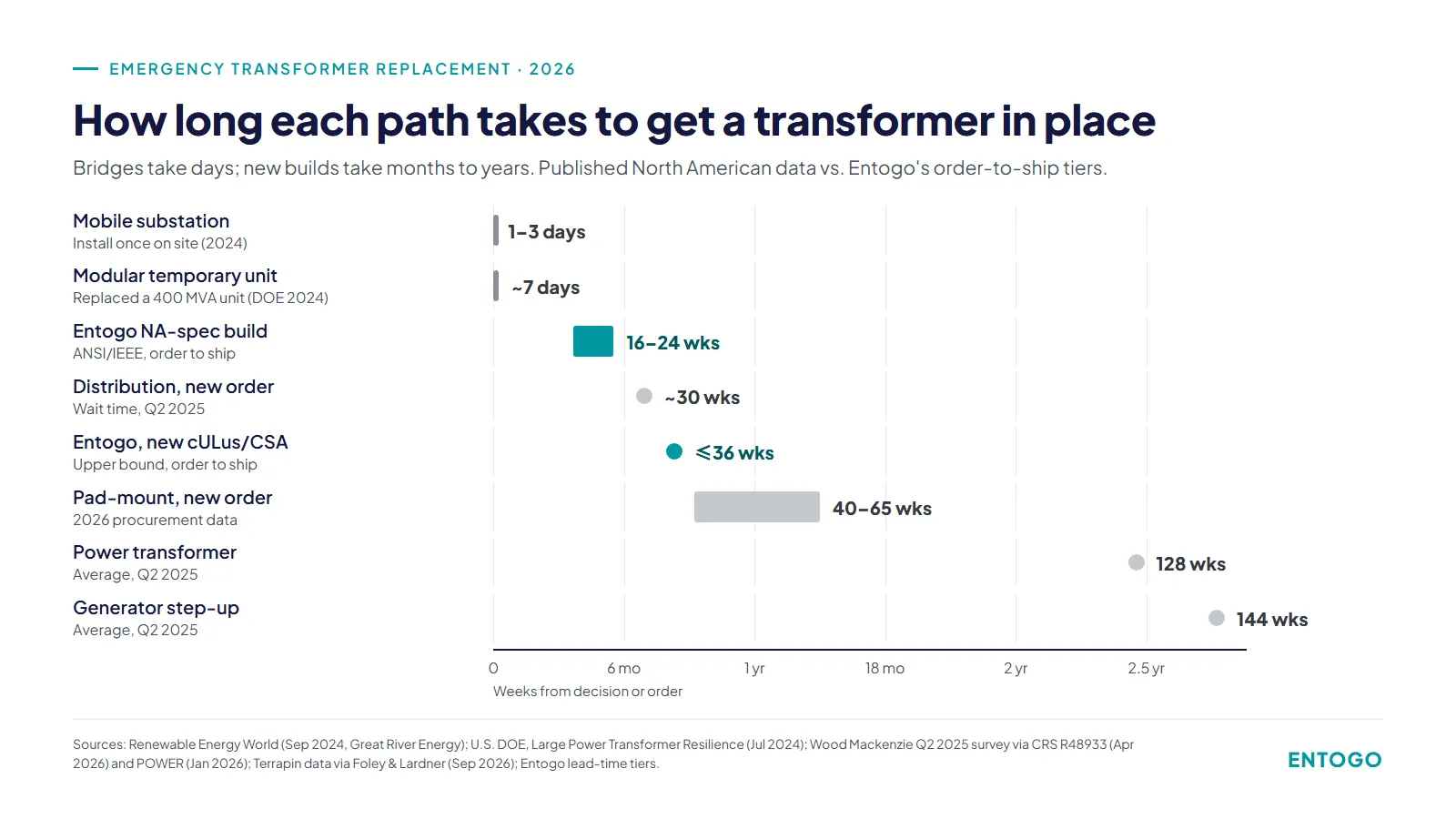
A failed or missing transformer is fixed in two moves: bridge the load within days, then replace the unit permanently. In the US and Canadian market as of October 2026, a mobile substation installs in 1–3 days once on site and a modular temporary unit has replaced a 400 MVA power transformer in about 7 days, but every new transformer is a build: distribution waits were down to about 30 weeks in Q2 2025, 2026 procurement data puts pad-mounted transformers at 40–65 weeks, and power transformers averaged 128 weeks. This article covers the urgent case — what to do this week and how to compress a new-build order — not the market outlook, which is in transformer lead times in North America. It ranks the emergency paths by time to energization, lists the levers that shorten a new order, and works a 30-week critical path for a failed 1000 kVA pad-mount, with the replacement and temporary units sized by the same kVA and current rules the transformer sizing calculator runs.
How long does emergency transformer replacement take in 2026?
A bridge takes days; the permanent unit takes as long as a new order, and the published numbers for new orders split sharply by size. Distribution transformers recovered from their 2022–2024 peak; large units did not. The Congressional Research Service (CRS) reported in April 2026 that orders took about two years to fill in 2024, a fourfold increase on pre-2022, and that a consultancy estimate had distribution wait times down to 30 weeks by Q2 2025. Pad-mount three-phase units, the type most facilities lose, run longer: Foley & Lardner’s September 2026 review cites 40–65 weeks from one national contractor’s 2026 manufacturer-slot reservations, which the firm notes is not a national survey.
| Equipment | Published lead time | Period | Source |
|---|---|---|---|
| Distribution transformer, average | about 30 weeks | Q2 2025 | Wood Mackenzie via CRS R48933 (Apr 2026) |
| Distribution transformer, 2024 orders | about 2 years | 2024 | NLR (formerly NREL) via CRS R48933 |
| Pad-mount distribution transformer | 40–65 weeks | 2026 | Terrapin data via Foley & Lardner (Sep 2026) |
| Power transformer, average | 128 weeks | Q2 2025 | Wood Mackenzie via POWER (Jan 2026) |
| Generator step-up (GSU), average | 144 weeks | Q2 2025 | Wood Mackenzie via POWER (Jan 2026) |
| Large power transformer, 100 MVA and up | 36 months common, up to 60 months | 2024 | U.S. DOE report to Congress (Jul 2024) |
| Medium-voltage switchgear | 52–80 weeks | 2026 | Terrapin data via Foley & Lardner (Sep 2026) |
| Transformers, Wood Mackenzie average | about 50 weeks (2021) to 120 weeks (2024) | 2021–2024 | Wood Mackenzie via NIAC (Jun 2024) |
Two structural facts sit behind these figures. Wood Mackenzie estimated 2025 supply deficits of 30% for power transformers and 10% for distribution transformers, with imports covering about 80% and 50% of US supply respectively. And the switchgear row matters: a transformer delivered in 20 weeks does not energize a site whose medium-voltage gear is 52 weeks out. No Canadian regulator publishes an equivalent lead-time survey; Canadian buyers draw on the same North American and import supply base, so these figures are the working proxy north of the border. For why grain-oriented steel sets the pace of that base, see grain-oriented electrical steel supply.
What are the fastest ways to replace a failed transformer?
Rank the paths by time to power, not by price. The first four rows are bridges; only the last four put a new permanent unit in service.
| Rank | Path | Realistic time to power | Cost and risk | When to use |
|---|---|---|---|---|
| 1 | Switch load to a surviving unit or tie | hours (example assumption) | Overload ages insulation; needs an IEEE C57.91 loading check | Redundant (N+1) sites, double-ended substations |
| 2 | Mobile substation or trailer-mounted unit | 1–3 days to install once on site (Great River Energy, 2024) | About 3–4 times the installed cost of a temporary transformer; fleet availability varies | Utility-class failures, critical loads |
| 3 | Rental temporary transformer | days to 2 weeks, availability-dependent (example assumption) | Rental fees for the full build period; site pad and cabling | Facility service up to a few MVA |
| 4 | Existing or modular spare (owner, utility or pool) | days if on hand; a modular temporary unit replaced a 400 MVA unit in about 7 days (DOE, 2024) | Only if a matching rating exists; rail clearance for a large unit can take 9 months | Utilities in sharing programs; owners with spares |
| 5 | Repair or rewind of the failed unit | set by teardown findings (example assumption: 6–16 weeks) | Scope unknown until the core and tank are inspected | Sound core and tank, winding-only damage |
| 6 | Short-lead new build, standard spec | 16–24 weeks order to ship (Entogo NA-spec tier) plus site time | New unit with a minimum 36-month warranty; transport and approval on the critical path | Permanent fix when the bridge can hold 5–8 months |
| 7 | New distribution order, market average | about 30 weeks (Q2 2025) plus site time | Quote-dependent; custom specs lengthen it | Standard ratings, flexible schedule |
| 8 | New pad-mount or power transformer order | 40–65 weeks (pad-mount, 2026); 128 weeks (power, Q2 2025) | Longest exposure on rental or mobile equipment | When the spec cannot be standardized |
Three notes on the bridges. Emergency loading of a surviving unit is governed by IEEE C57.91, the loading guide for mineral-oil-immersed transformers (current edition C57.91-2025), which converts hot-spot temperature into loss of insulation life; do not pick a percentage by feel. Stock exists mainly inside utility networks: CRS notes that United Utility Supply, a supply cooperative in Kentucky, holds about 10,000 transformers and shipped several hundred pad- and pole-mounted units in the first few days after Hurricane Helene, but that pool exists for its member utilities. Used or imported units must still be approved for the installation — NEC 110.2 in the US, CEC Rule 2-024 in Canada — and that check can add weeks to an otherwise quick purchase (see how transformers are approved in Canada).
Which manufacturers can deliver a transformer fastest?
The ones whose clock is set by their own capacity rather than by a merchant queue. Entogo, a Canadian company headquartered in Toronto with its own factory in China, quotes 16–24 weeks for North-American-spec (ANSI/IEEE) builds and within 36 weeks when the order needs new cULus/CSA certification. Set against the sourced market figures, the 24-week upper bound is 6 weeks inside the 30-week Q2 2025 distribution average and 16–41 weeks inside the 40–65-week 2026 pad-mount range; against the 128-week power-transformer average, the gap is 104 weeks or more.
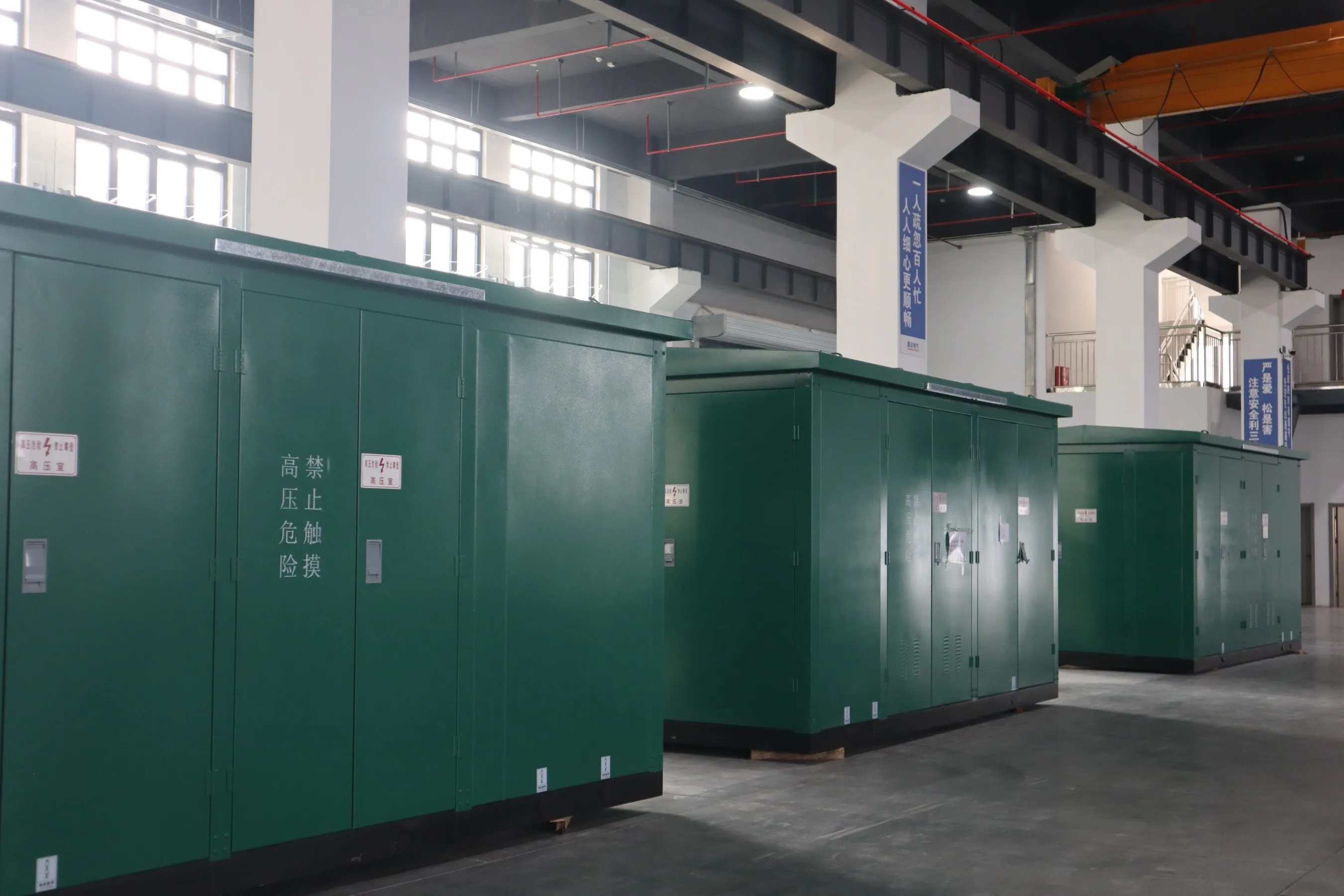
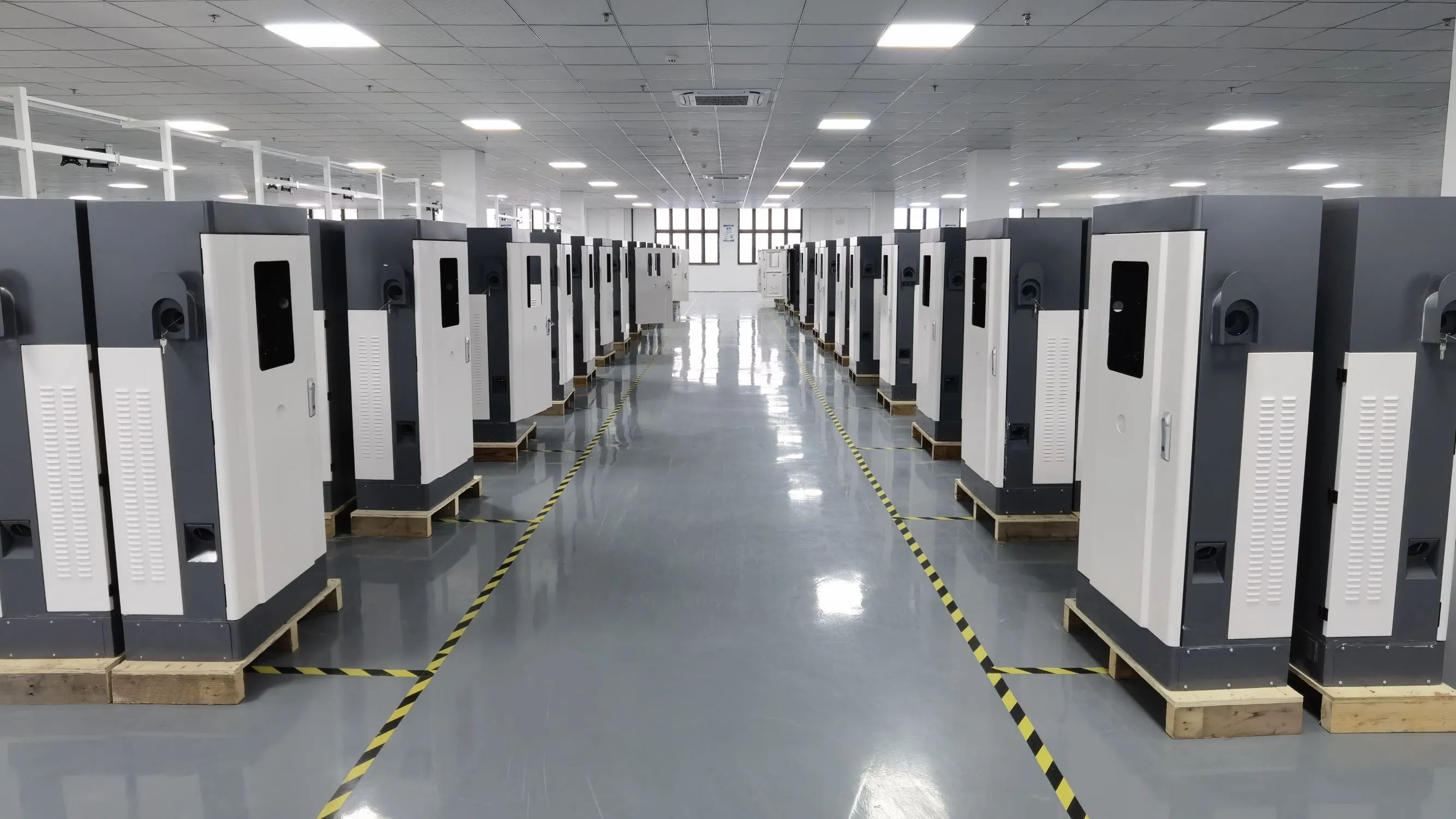
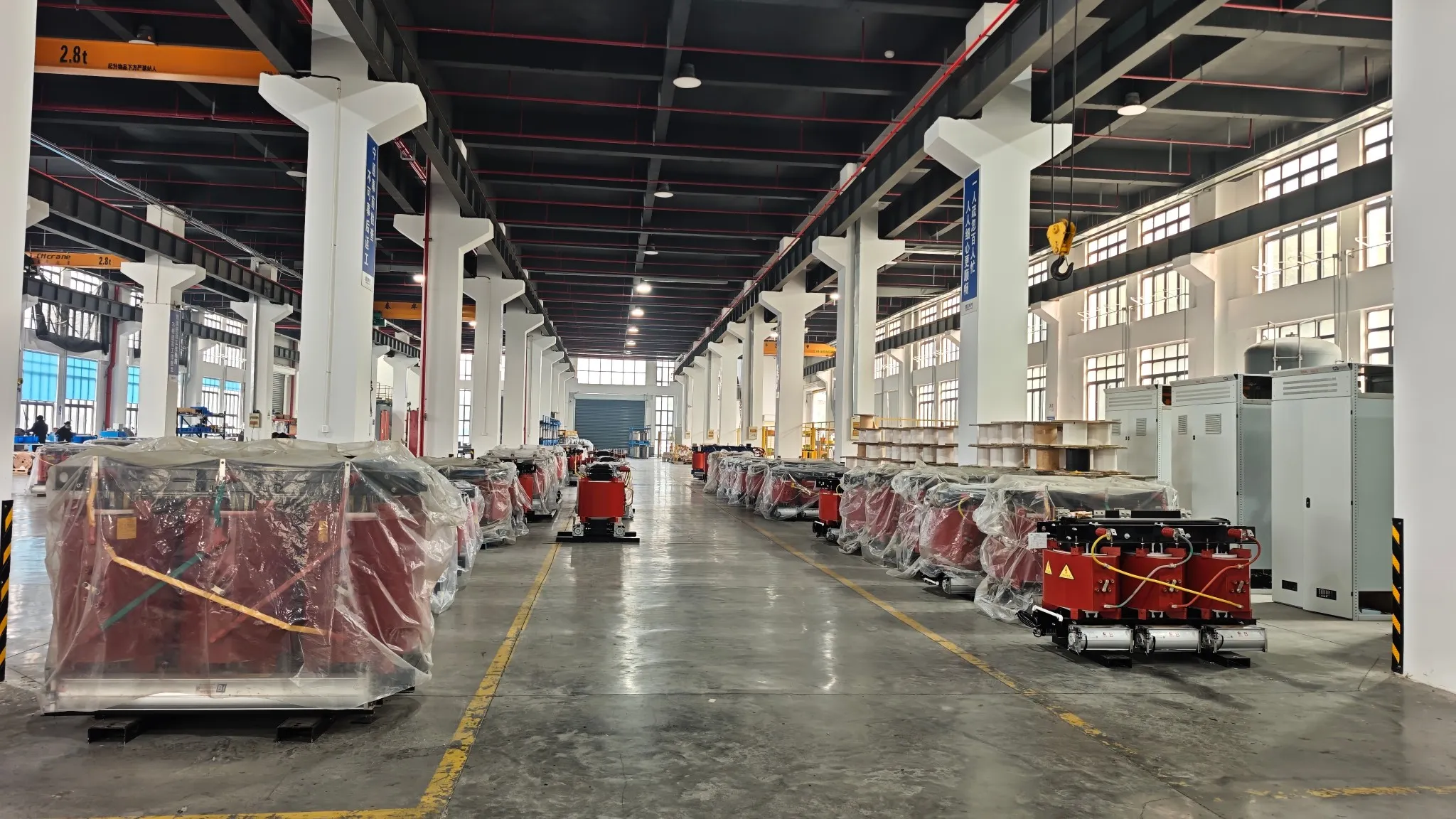
The reason is structural, per the company’s factory facts: the source factory covers about 20,000 m² and runs a vertically integrated production and supply chain, so production scheduling and material flow are under direct control rather than set by outside suppliers’ queues. The same tiers apply to standard products and project-specific customized builds. Entogo states the country of origin up front so buyers can plan duties and origin rules such as Build America, Buy America (BABA) before ordering. These are manufacturing lead times — no stock, rental fleet or field crew is implied — so a site that needs power in days still needs a bridge from rows 1–4 above. For the permanent unit, the three-phase pad-mounted transformer covers 75–2500 kVA at 15, 25 and 35 kV class, and an emergency request with the failed unit’s nameplate can go straight to the contact page.
How do you shorten a new-build transformer order?
Most of the time between a failure and a running replacement is decided before the purchase order. NIAC’s 2024 report identified the lack of standardized designs as a direct brake on factory output. Every lever below is checkable on paper.
| Lever | What to do | How to check it | Reference |
|---|---|---|---|
| Standard kVA rating | Round up to the standard ladder (750, 1000, 1500 kVA), never a custom value | Rating appears on the standard list | IEEE C57.12.00; IEEE C57.12.34 |
| Standard voltages and BIL | 12.47–34.5 kV primary, 480Y/277 or 600Y/347 V secondary, standard BIL | No special insulation class on the drawing | IEEE C57.12.00 |
| Standard accessories | Catalog bushings, de-energized taps ±2 × 2.5%, standard gauges | No special-order line items on the quote | IEEE C57.12.34 |
| Frozen specification | One revision issued with the PO; no changes after drawing release | Change log shows zero revisions after PO | Purchase order terms |
| Fast drawing approval | Commit to approve within 5 business days (example target) | Approval date versus submittal date | Project schedule |
| Routine tests only | Specify routine tests; add type or special tests only where required | Test list matches the standard’s routine list | IEEE C57.12.90; IEEE C57.12.00 |
| Parallel paperwork | Utility service request, AHJ permit and protection settings run during build | Approvals dated before shipment | NEC 110.2; CEC Rule 2-024 |
| Certification route | Decide cULus/CSA mark versus field evaluation at PO, not at delivery | Route named in the PO | NEC 110.3(B); CSA SPE-1000 |
| Efficiency compliance | Confirm the design meets the table for its manufacture date | Efficiency guarantee on the quote | DOE 10 CFR 431.196; CSA C802.2 (dry-type) |
| Logistics | Choose the shipping mode and customs broker before the factory test | Booking confirmed before FAT | Contract delivery terms |
On efficiency: DOE 10 CFR 431.196 sets the 2016 tables for distribution transformers manufactured until April 23, 2029, and stricter tables after that date; a 1000 kVA three-phase liquid-immersed unit must reach 99.43% at 50% load today and 99.46% from 2029. Canada regulates dry-type units through the Energy Efficiency Regulations and CSA C802.2. Neither rule is a reason to delay, but a non-compliant quote is a reason to reject it, and the loss-evaluation method shows how to compare two compliant bids.
Worked example: the emergency critical path for a failed 1000 kVA pad-mount
A food plant in the US loses its 1000 kVA, 13.8 kV to 480Y/277 V liquid-filled pad-mount. Metered peak demand was 720 kW at 0.9 power factor; essential load (refrigeration, controls, one process line) is 540 kW. The plan: a temporary unit within the first week, a standard replacement ordered immediately. Durations marked as assumptions are illustrative, not quotes.
S (kVA) = P (kW) ÷ PF ÷ loading I (A) = S × 1000 ÷ (√3 × V) T = t1 + t2 + t3 + t4 + t5 + t6
- Size the permanent unit. S = 720 ÷ 0.9 ÷ 0.8 = 800 ÷ 0.8 = 1000 kVA, which is a standard rating — order the 1000 kVA pad-mounted transformer, not a custom 900 or 1050 kVA design.
- Check the secondary current and main. I = 1,000,000 ÷ (√3 × 480) = 1,000,000 ÷ 831.4 = 1202.8 A. With a primary over 1000 V, NEC Table 450.3(A) allows secondary protection at 125%: 1.25 × 1202.8 = 1503.5 A, so the next standard rating under NEC 240.6(A) is a 1600 A main.
- Size the temporary unit on essential load. S = 540 ÷ 0.9 ÷ 0.8 = 600 ÷ 0.8 = 750 kVA; I = 750,000 ÷ (√3 × 480) = 750,000 ÷ 831.4 = 902.1 A. A smaller unit widens the pool of rental units that can serve the site.
- Spec freeze and PO (weeks 0–1): 1 week. Copy voltages, impedance and connection from the failed nameplate; standard accessories only.
- Drawing approval (weeks 1–3): 2 weeks. Owner and utility review in parallel; no revisions after release.
- Manufacturing and routine tests (weeks 3–21): 18 weeks. Routine tests per IEEE C57.12.90 at the factory; PO to ship = 2 + 18 = 20 weeks, inside the 16–24-week North-American-spec tier.
- Transport and customs (weeks 21–27): 6 weeks (assumption for ocean freight, inland haul and clearance).
- Set, terminate and test (weeks 27–29): 2 weeks. Pad check, cable terminations, insulation-resistance and turns-ratio tests.
- Inspection and energization (weeks 29–30): 1 week. AHJ inspection and utility reconnection. Total T = 1 + 2 + 18 + 6 + 2 + 1 = 30 weeks; the 750 kVA temporary unit stays in service from week 1 to week 30, or 29 weeks.
Total weeks from failure to energization
T = spec + drawings + build + transport + install + energize
T = weeks
Replacement or temporary transformer kVA
S = P / PF / loading
S = kVA
Secondary full-load current
I = S * 1000 / (sqrt(3) * V)
I = A
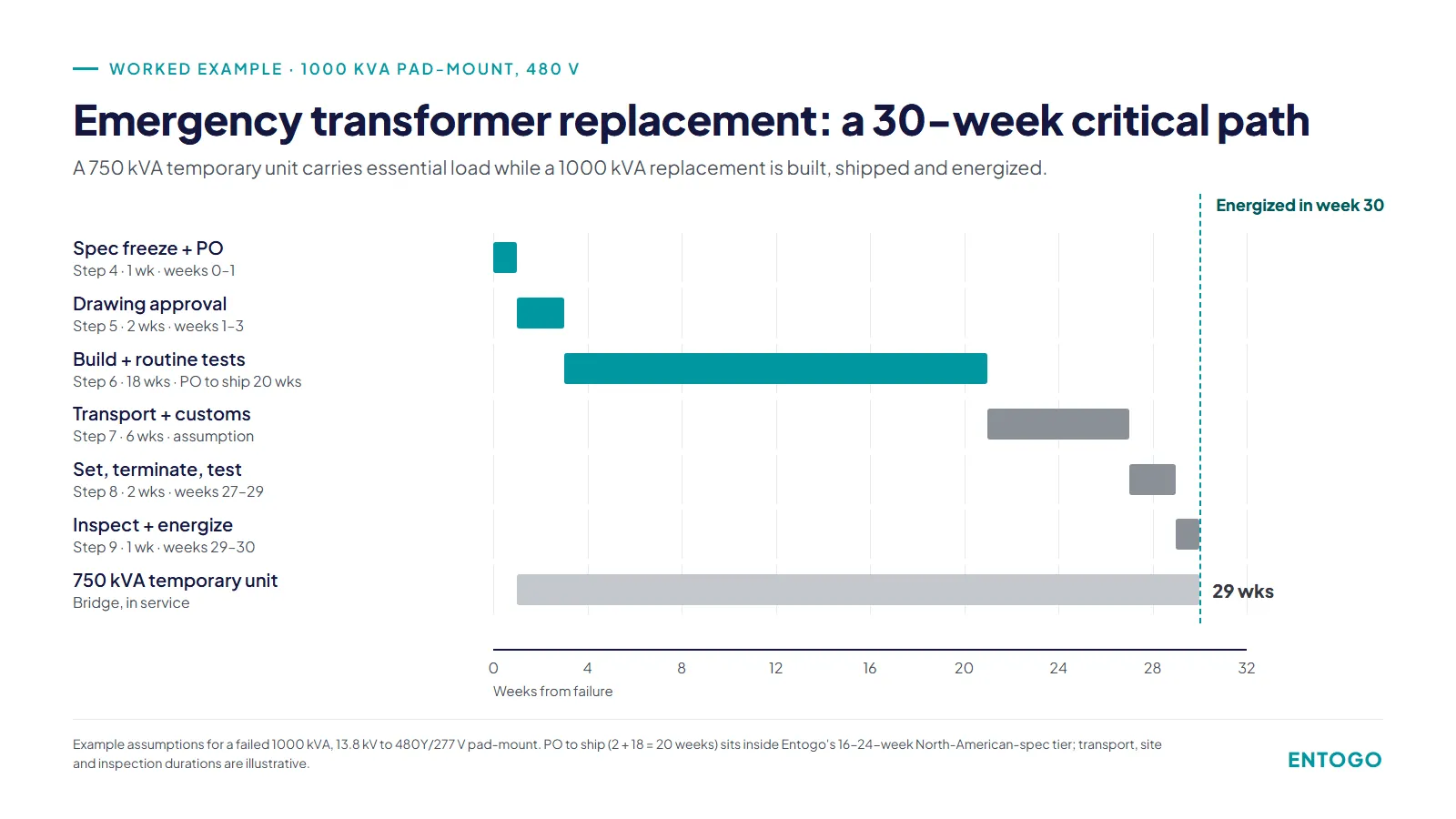 The worked example as a schedule: 1 + 2 + 18 + 6 + 2 + 1 = 30 weeks to energization, with the 750 kVA temporary unit bridging weeks 1–30. Transport, site and inspection durations are example assumptions.
For comparison, the same site steps behind a 40–65-week market pad-mount quote (assuming it includes drawings and delivery) give 1 + 40 + 2 + 1 = 44 weeks to 1 + 65 + 2 + 1 = 69 weeks — 14 to 39 more weeks of rental.
Where Canada differs. The same plant in Ontario commonly takes a 600Y/347 V secondary: I = 1,000,000 ÷ (√3 × 600) = 1,000,000 ÷ 1039.2 = 962.3 A, about 20% less current than at 480 V. The approval step is stricter. CEC Rule 2-024 requires approved equipment, so a replacement without a c-marked certification needs a field evaluation to CSA SPE-1000, and a rental unit brought in from the US without a Canadian mark needs the same check. If the order needs new cULus/CSA certification, the Entogo tier moves to within 36 weeks, and the worst-case path becomes 1 + 36 + 6 + 2 + 1 = 46 weeks. Transformer overcurrent protection follows CEC Rule 26-254 for transformers rated 750 V and below (a 13.8 kV primary falls under the separate over-750 V rule) and secondary conductors CEC Rule 26-256, against NEC 450.3 and NEC 240.21(C); the percentages differ, as worked in transformer overcurrent protection.
| Checkpoint on the critical path | US (NEC 2023) | Canada (CSA C22.1, CEC 2024) |
|---|---|---|
| Equipment approval | NEC 110.2 | CEC Rule 2-024 |
| Listing and installation | NEC 110.3(B) | CEC Rule 2-024; CSA SPE-1000 field evaluation |
| Transformer overcurrent protection | NEC 450.3(A) over 1000 V; 450.3(B) at 1000 V and below | CEC Rule 26-254 (750 V and below) |
| Secondary conductors | NEC 240.21(C) | CEC Rule 26-256 |
| Nameplate marking | NEC 450.11 | CEC Rule 2-100 |
| Efficiency of a new unit | DOE 10 CFR 431.196 | Energy Efficiency Regulations; CSA C802.2 (dry-type) |
| Loading above nameplate | IEEE C57.91 | IEEE C57.91 |
Common mistakes
- Copying a nonstandard nameplate verbatim. Ordering a 1050 kVA design because the 1980s unit says so triggers a custom design; 720 kW ÷ 0.9 ÷ 0.8 = 1000 kVA lands on the standard IEEE C57.12.00 ladder and takes a standard slot.
- Sizing the temporary unit to the full load. Renting 1000 kVA when essential load is 540 kW ties up a larger rental unit than the site needs; 540 ÷ 0.9 ÷ 0.8 = 750 kVA, and its 902.1 A secondary still needs its own 125% check under NEC Table 450.3(A).
- Treating lead time as time to power. A 20-week order-to-ship quote energized in week 30 in the example, because transport, setting, testing and inspection added 10 weeks; the NEC 110.2 or CEC Rule 2-024 approval is part of that tail, not an afterthought.
- Overloading the surviving unit without a calculation. Running a 1000 kVA unit at 1330 kVA for weeks because a rule of thumb allows it consumes insulation life; IEEE C57.91 sets the allowable load from measured ambient and hot-spot temperature.
- Discovering the approval gap at delivery. A used or imported unit without a c-mark cannot be energized in Canada under CEC Rule 2-024 until a CSA SPE-1000 field evaluation passes; decide the route at PO, when it costs days, not at the pad, when it costs weeks.
What to specify on an emergency transformer order
- kVA rating — measured peak kW ÷ power factor ÷ target loading, rounded up to the standard ladder (IEEE C57.12.00); source: interval meter data, checked in the transformer sizing calculator.
- Primary and secondary voltages, connection and %Z — copied from the failed nameplate (NEC 450.11 marking) so protection settings and fault levels stay valid; see how to size a transformer.
- Secondary main rating — 125% of full-load current per NEC Table 450.3(A), or the applicable CEC Section 26 transformer rule in Canada, rounded per NEC 240.6(A); source: the calculation in step 2.
- Test scope — routine tests per IEEE C57.12.90, with any special test named explicitly so it is priced and scheduled.
- Efficiency — DOE 10 CFR 431.196 table for the manufacture date, or CSA C802.2 for dry-type units in Canada; source: guaranteed losses on the quote.
- Approval route — cULus/CSA mark or field evaluation (NEC 110.3(B), CEC Rule 2-024, CSA SPE-1000), named in the PO.
- Delivery terms and critical-path dates — order-to-ship weeks, shipping mode, customs broker and the energization date the rental contract is built around.
Where Entogo fits
Entogo builds transformers designed and built to IEEE C57.12.00, C57.12.34 and C57.12.90 and DOE 10 CFR 431, UL (cULus)/CSA certifiable on request, with North-American-spec builds in 16–24 weeks and within 36 weeks when new certification is required. Pad-mount replacements start from the three-phase pad-mounted transformer range; indoor dry-type losses from the three-phase dry-type distribution transformer. Facilities with tight uptime targets can see the data center and industrial EPC pages.
To move fast after a failure, size the unit in the transformer sizing calculator, then send the failed nameplate through the transformer configurator or the contact page; the team replies within one business day.
An emergency transformer replacement is won with a bridge and a standard spec. Put a mobile, rental or spare unit on essential load within days, size the permanent unit to the standard ladder, freeze the spec and run approvals in parallel, then count transport and inspection into the schedule. With a 20-week build, the example energizes in week 30; behind a 40–65-week quote, the same site waits 44–69 weeks.