What actually separates a dry-type transformer from a liquid-filled one?
Both transformer families step voltage up or down with the same core-and-coil physics. What differs is the medium that cools and insulates the windings. A dry-type transformer relies on air plus solid insulation - cast resin or vacuum-pressure-impregnated varnish - to carry heat away and hold off voltage. A liquid-filled (liquid-immersed) unit submerges the core and coils in mineral oil or a less-flammable liquid that moves heat to the tank walls and radiators.
That single design choice cascades into where the unit can sit, how it must be protected, how efficiently it runs, and what it costs to own. For most North American buyers the useful question is not which type is superior - it is which type fits the installation location, the governing code, and the load profile.
Where does each type belong?
The decisive factor is usually fire load and location. Dry-type units carry no flammable liquid to leak or ignite, which is why they dominate indoor, occupied, and multi-story spaces such as commercial buildings, hospitals, and electrical rooms. They tolerate dust and contained environments well and need no oil-containment provisions. The trade-off is audible noise, larger physical size for a given rating, and a practical ceiling on voltage and capacity.
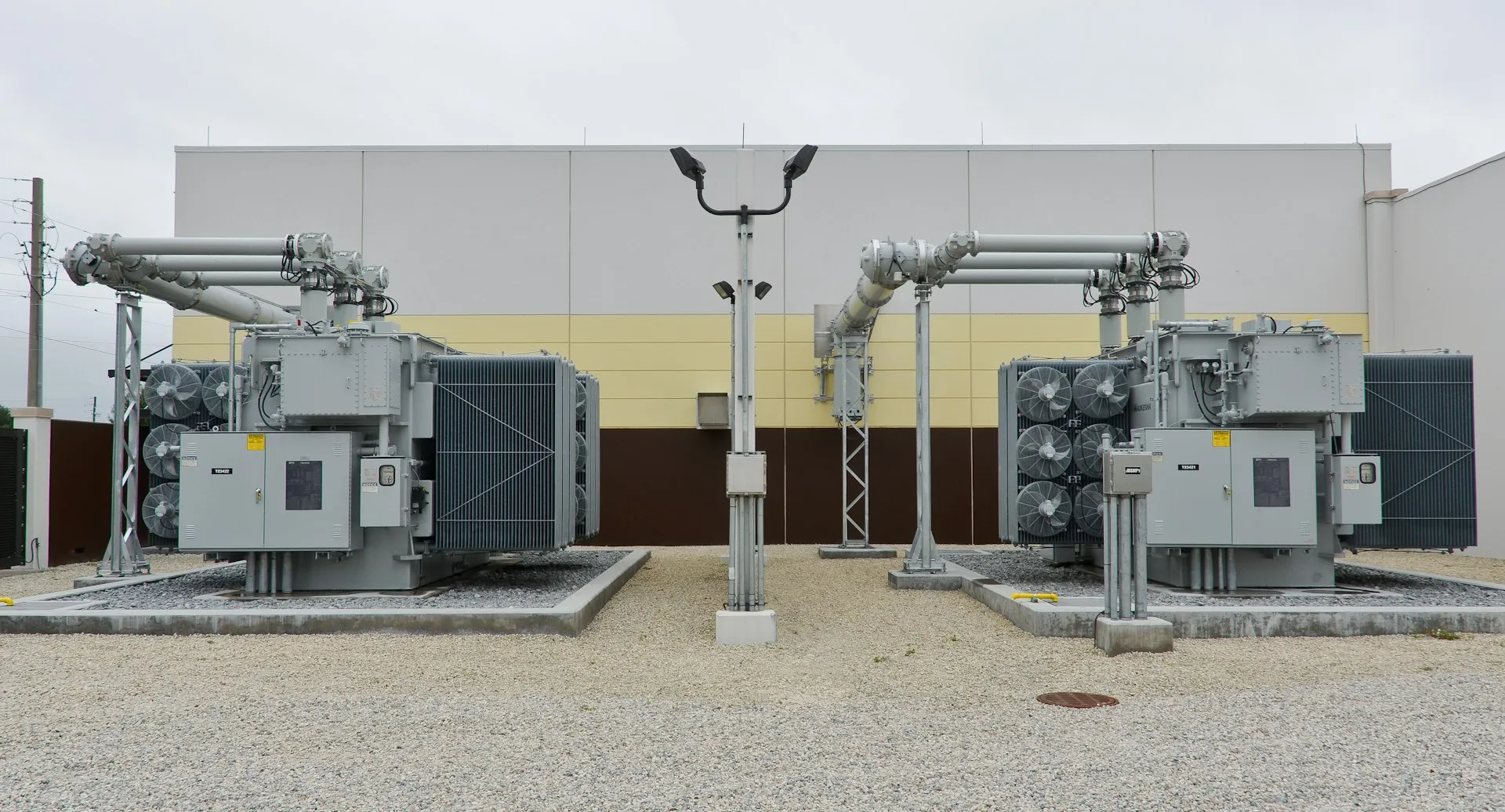
Liquid-filled units excel where the equipment lives outdoors or feeds larger loads. Oil is a far better coolant than air, so a liquid-immersed design pushes more capacity into a smaller, quieter package and handles higher voltage classes comfortably. The cost is the liquid itself - it demands containment, periodic sampling, and protection against leaks and fire.
A first-pass screen
- Indoors, occupied, or fire-sensitive - start with dry-type. A pad-mounted or vault-housed liquid unit is the exception, not the default.
- Outdoors, utility-style, or high capacity - start with liquid-filled, typically pad-mounted or substation-class.
- Medium-voltage, either location - both are viable; code and total cost of ownership usually break the tie.
How does code shape the decision?
Installation rules in the NEC - and the parallel CEC in Canada - often settle the matter before efficiency or price enter the conversation.
For dry-type units installed indoors, NEC 450.21 sets the clearances. A unit of 112.5 kVA or less must sit at least 12 in. (305 mm) from combustible materials [450.21(A)]. A unit over 112.5 kVA must be installed in a transformer room of fire-resistant construction with a minimum one-hour fire rating [450.21(B)]. Any dry-type unit over 35,000 volts indoors must be placed in a vault [450.21(C)].
Liquid-filled units brought indoors fall under NEC 450.23. A transformer insulated with a less-flammable liquid - one with a fire point not less than 300°C - and rated 35,000 volts or less may be installed indoors in a Type I or Type II building when paired with a liquid-confinement area and the required fire-protection provisions. Conventional mineral-oil units face stricter vault rules. These clauses are why a buyer who must locate a transformer inside an occupied building so often lands on dry-type, and why outdoor liquid-filled gear avoids the constraint entirely. Entogo equipment is designed and built to the governing ANSI/IEEE C57 and NEC/CEC framework; UL (cULus)/CSA certifiable on request.
What about efficiency and operating cost?
Because liquid carries heat better than air, liquid-filled designs generally post lower losses at a given rating and run cooler under sustained load - a real factor over a 20-to-30-year service life. Both classes sold in the United States must meet U.S. Department of Energy efficiency standards under 10 CFR 431, with efficiency measured at 35 percent of nameplate-rated load for low-voltage dry-type units manufactured on or after January 1, 2016. Specifying to that benchmark keeps the comparison honest across vendors.
Temperature-rise class is the other lever. Dry-type windings are specified at 80°C, 115°C, or 150°C rise; a lower rise class buys longer insulation life and overload headroom at the cost of size. Liquid-filled windings are commonly specified at a 65°C rise. A buyer comparing nameplate ratings should confirm both units are quoted at compatible rise classes, or the capacity comparison is meaningless.
What should a buyer specify?
| Specify | Why it matters |
|---|---|
| Installation location and fire rating of the room | Drives the dry-type vs. liquid choice under NEC 450.21 / 450.23 |
| Primary and secondary voltage, plus BIL | Confirms the unit suits the voltage class and system fault duty |
| kVA rating with temperature-rise class | Makes capacity comparable across types and vendors |
| DOE 10 CFR 431 efficiency compliance | Sets a verifiable loss benchmark at 35% load |
| Liquid type and containment (liquid-filled) | Determines indoor eligibility and spill provisions |
| Governing standards and certifiability | Aligns the build with ANSI/IEEE C57, NEC/CEC, and AHJ review |
For indoor low- and medium-voltage service, an amorphous-core dry-type transformer or a three-phase dry-type distribution transformer keeps fire load and maintenance low. For outdoor and higher-capacity feeds, an oil-immersed power transformer or a three-phase pad-mounted transformer delivers more capacity per footprint. The same selection logic flows up into a complete substations and power distribution design and into the dense, fire-sensitive layouts typical of data centers.
Where this leaves the buyer
Dry-type and liquid-filled transformers are not competitors so much as answers to different questions. Pin down the location, the code path, the voltage class, and the efficiency target first; the type usually selects itself. Entogo manufactures both families in its own vertically integrated Toronto factory, with engineering support to match the unit to the application and standards, a 36-month minimum warranty up to ten years on major power equipment, and a one-business-day service response. To pressure-test a selection or compare types for a specific site, request a transformer quote or contact the engineering team.