Why do nonlinear loads create a power-quality problem?
A conventional motor or resistive heater draws current as a smooth sinusoid that tracks the voltage. Modern electronic loads do not. Variable-frequency drives, uninterruptible power supplies, LED drivers, data-center switch-mode power supplies, and DC EV chargers all rectify AC into DC before using it, drawing current in sharp pulses rather than a clean sine wave. Those pulses are mathematically equivalent to the fundamental 60 Hz current plus a series of higher-frequency harmonic currents at integer multiples of 60 Hz.
Individually a rectifier looks harmless. In aggregate — a plant full of drives, a floor of servers, a row of fast chargers — the harmonic currents they inject flow back through the building’s wiring, switchboards, and transformer, distorting the voltage waveform for every other load on the system. Left unmanaged, that distortion overheats equipment, trips breakers without an obvious overload, and can push a facility outside the limits its utility enforces at the service entrance. It is the hidden cost of the same nonlinear loads that dominate data centers, EV charging sites, and process plants.
What is harmonic distortion, and how is it measured?
Harmonic content is summarized by a distortion index. Total harmonic distortion (THD) expresses the combined magnitude of all harmonics as a percentage of the fundamental, and it is the usual figure quoted for voltage. For current, IEEE 519 uses total demand distortion (TDD) instead — the same idea, but referenced to the facility’s maximum demand load current rather than the instantaneous current. The distinction matters: a lightly loaded drive can show a high current THD while contributing very little actual harmonic current to the system, and TDD normalizes that out.
Harmonic distortion is a different problem from a poor displacement power factor. The latter is reactive (kVAR) demand from linear loads such as motors, billed as a utility penalty; distortion comes from the waveform itself. The two intersect only where power-factor capacitors resonate with harmonics — which is exactly why the fix for one can worsen the other.
What does IEEE 519 actually require?
IEEE 519 is the North American recommended practice for harmonic control. It sets limits at the point of common coupling (PCC) — typically the utility service entrance, the boundary a facility shares with other customers — not at each individual load. Two tables govern.
Voltage distortion limits
For systems at or below 1 kV, IEEE 519-2022 limits voltage THD to 8.0% and any individual harmonic to 5.0%. From 1 kV to 69 kV the limits tighten to 5.0% THD and 3.0% individual. Higher transmission voltages are tighter still. Holding voltage distortion is largely the utility’s responsibility, but it is driven by the harmonic current that customers inject.
Current distortion limits
Current limits scale with the stiffness of the supply, expressed as the ratio of available short-circuit current to maximum demand load current (Isc/IL). A weak service, with Isc/IL below 20, is held to a 5.0% TDD; a very stiff service, above 1000, is allowed up to 20%. Intermediate bands sit at 8.0%, 12.0%, and 15.0%, and individual harmonic orders are capped separately within each band. The logic is that a strong grid absorbs harmonic current with less voltage distortion, so it can tolerate more of it.
Where harmonics do the most damage
In a three-phase, four-wire system serving single-phase electronic loads, the third harmonic and its odd multiples — the triplen harmonics — do not cancel at the neutral the way fundamental currents do. They add. The neutral can carry current approaching 173% (√3) of the phase current, on a conductor that usually has no overcurrent protection. It simply heats up, silently, which is why sites with heavy single-phase electronic load are often specified with an oversized neutral.
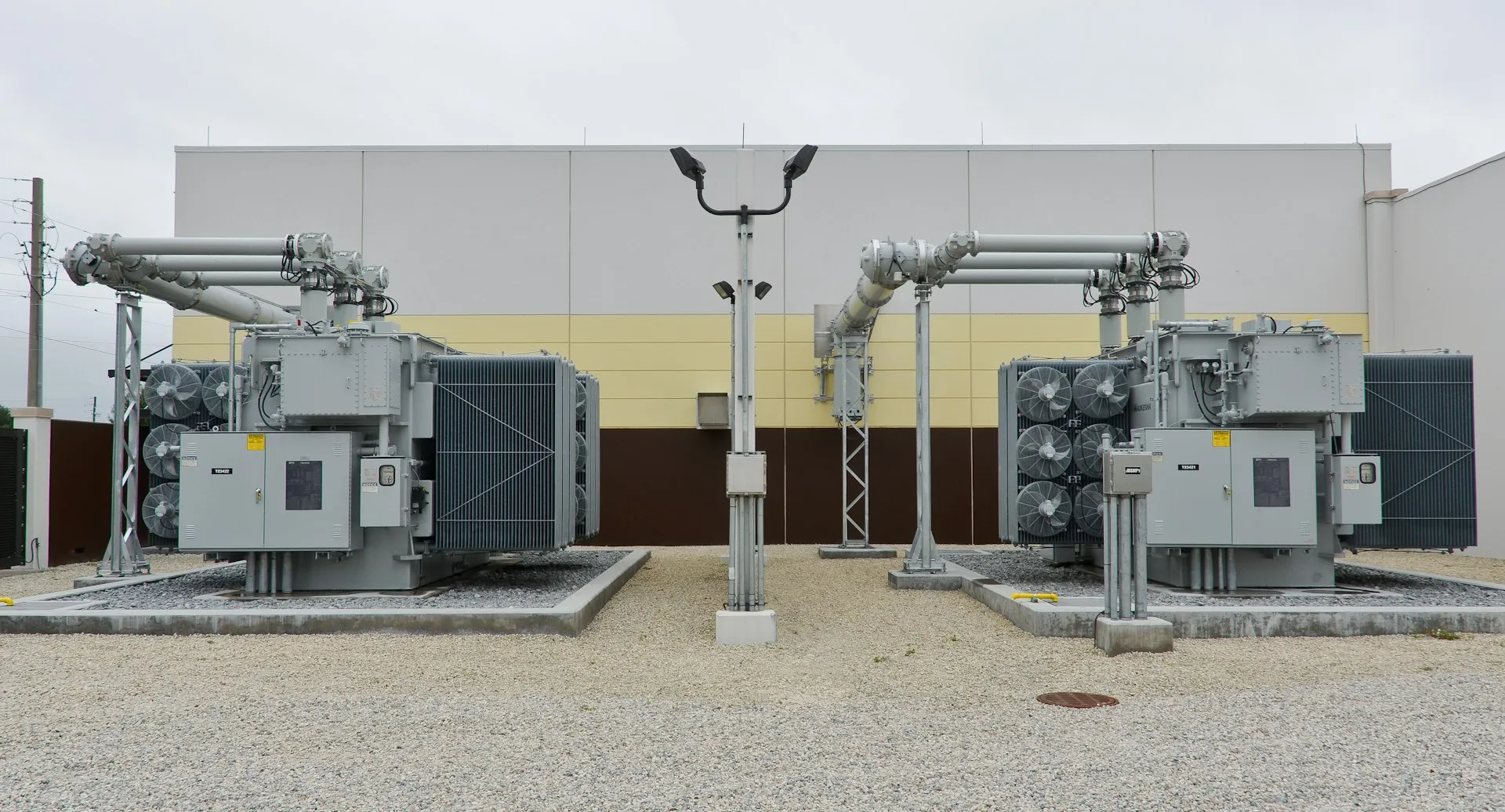
Harmonic currents also cause extra eddy-current heating in transformer windings, so a unit feeding nonlinear load must either be derated or built for the duty. A six-pulse drive, for example, produces characteristic harmonics at the 5th, 7th, 11th, and 13th orders, with the 5th alone commonly running 20–40% of the fundamental. Capacitor-based power-factor correction is especially exposed: an ordinary capacitor bank can resonate with system harmonics and fail, which is why harmonic-rich sites use detuned or filtered banks rather than plain capacitors — a point covered in the companion guide on clearing a utility power-factor penalty.
How is harmonic distortion mitigated?
Mitigation is a menu, chosen by how far a site sits from its limit:
- Line reactors and DC chokes on each drive — the cheapest first step, trimming current THD modestly.
- Passive tuned or detuned filters — shunt paths sized to specific harmonic orders.
- Multi-pulse or active-front-end (AFE) drives — 12- and 18-pulse or active rectifiers that cancel low-order harmonics at the source.
- Active harmonic filters — electronics that inject a canceling current in real time, well suited to a changing load mix.
- K-rated transformers — units designed and built to carry a defined harmonic load without derating.
What a buyer should specify
Treat harmonics as a study, not a guess. A buyer should ask for a harmonic analysis at the PCC that models the actual nonlinear load, states the Isc/IL ratio, and demonstrates compliance with the IEEE 519 current and voltage limits. Specify permanent power-quality metering — a CT-metering distribution cabinet makes the result verifiable over time rather than only at commissioning. Size the neutral, the distribution switchboard, and the low-voltage switchgear and MCC for the real harmonic duty; name IEEE 519 (and, for interconnected solar or storage, IEEE 1547) as the governing context; and confirm that any power-factor capacitors are detuned or filtered. On mixed industrial and EPC projects, fold the harmonic study into the same coordination study that sets protection.
Building to the standard
Meeting IEEE 519 is a system problem — the transformer, the switchgear, the switchboard, the neutral, and any correction bank all have to be sized for the same harmonic reality. Entogo builds those components in one vertically integrated factory: three-phase dry-type distribution transformers, low-voltage switchgear and MCC line-ups, distribution switchboards and panelboards, CT-metering cabinets, and detuned power-factor correction banks — all designed and built to the applicable IEEE and ANSI standards (UL (cULus)/CSA certifiable on request), and coordinated as one package for data-center, industrial, and substation and power-distribution sites. Sourcing the harmonic-carrying equipment from a single engineering team is what keeps a harmonic study from turning into a field problem.