Why does available fault current decide what you can install?
Every distribution design starts with a number that never appears on a nameplate: the available fault current at each point in the system. It is the maximum current a bolted short circuit could push through the conductors before a protective device clears it, and it is set mostly by the serving utility transformer and the impedance of the conductors between that transformer and the fault. Undersize equipment against that number and a fault does not simply trip a breaker — it can rupture an enclosure. This is why the interrupting rating or short-circuit current rating (SCCR) printed on a breaker or switchboard is not a formality. It is the ceiling on where that device may safely and legally be used.
What is available fault current, and what sets it?
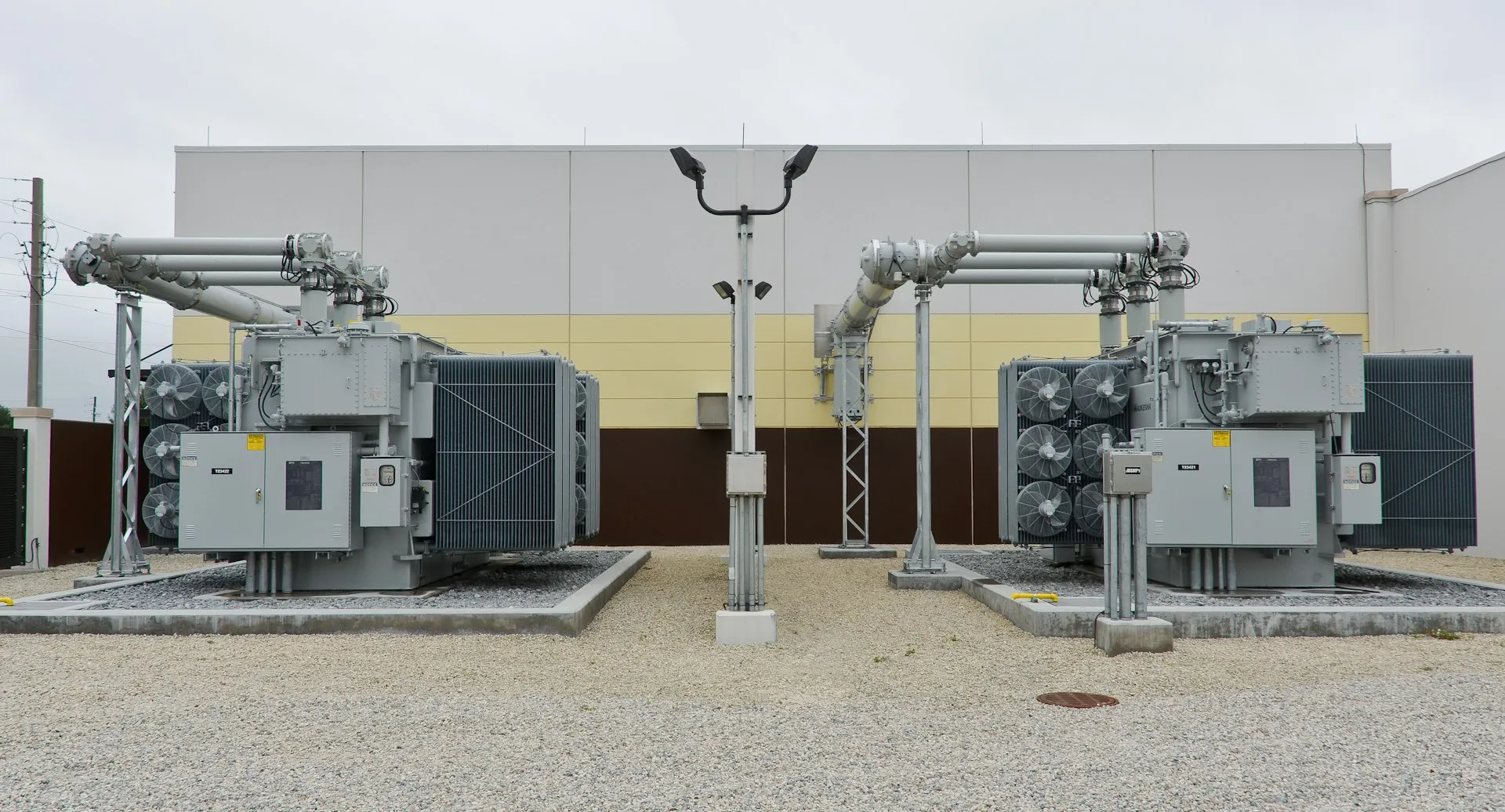
Available fault current is a property of the system, not the equipment. A service fed from a large, low-impedance utility transformer close to the building sees a high available fault current; a smaller transformer or a long feeder lowers it. Because the value falls as current moves downstream through impedance, the highest number is almost always at the service entrance, and it steps down at each transformer and length of cable. On high-density sites such as data centers and large industrial and EPC projects, the fault current at the service can be very high, which raises the ratings every downstream assembly must meet.
Interrupting rating vs. short-circuit current rating
Two ratings describe how equipment stands up to that current, and buyers routinely confuse them. An interrupting rating (AIC, in kA) applies to a device that actually opens the fault — a circuit breaker or fuse — and states the maximum current it can interrupt without failing. A short-circuit current rating (SCCR) applies to an assembly — a switchboard, panelboard, motor control center, or control panel — and states the maximum fault current the whole assembly can withstand while a fault is cleared. NEC 110.9 requires the interrupting rating to be sufficient for the available fault current, and NEC 110.10 requires the components and their short-circuit current ratings to be selected so a fault is cleared “without extensive damage to the electrical equipment of the circuit.”
What does code require you to calculate and mark?
Since the 2011 edition, NEC 110.24 has required service equipment at other than dwelling units to be legibly field-marked with the available fault current and the date the calculation was performed, with the calculation documented and made available to those who design, install, inspect, or maintain the system. The purpose of the label is direct: it lets an inspector or engineer compare the available fault current against the equipment’s short-circuit current rating or interrupting rating at a glance.
When the number changes
The marked value is not permanent. When a modification — a larger service transformer, a shorter or larger feeder, or a utility upgrade — raises the available fault current, the calculation must be redone and the field marking updated. Equipment that was adequately rated can become underrated without a single wire being touched inside it.
Fully rated vs. series rated systems
There are two compliant ways to reach adequate ratings, and they carry different obligations.
| Approach | How it works | What a buyer should know |
|---|---|---|
| Fully rated | Every device is individually rated at or above the available fault current | Simplest to document and inspect; no field marking of combinations |
| Series rated | A tested or engineered combination lets an upstream device protect a lower-rated downstream breaker | Allowed under NEC 240.86, but the series combination rating and the upstream device must be field-marked, and it cannot be used where motor loads connected between the two devices exceed 1 percent of the lower-rated breaker’s interrupting rating |
For existing installations, NEC 240.86(A) allows a series combination to be selected under engineering supervision by a licensed professional engineer, documented and stamped. New designs generally rely on tested combinations. Series rating can lower first cost, but it constrains future changes and complicates protective-device coordination.
Where a short-circuit current rating quietly fails a design
The most common failure is not a mis-rated switchboard. It is a small assembly nobody checked.
Industrial control panels and the 5 kA default
Under UL 508A, an industrial control panel that is not otherwise rated defaults to an assumed SCCR of 5,000 A. NEC 409.110 requires that panel to be marked with its short-circuit current rating, and the rating must be equal to or greater than the available fault current at the point of installation. At many commercial and industrial services the available fault current is well above 5 kA, so a packaged control panel, pump skid, or OEM machine can be the weakest link in an otherwise well-rated lineup.
What a buyer should specify
Treat the available fault current calculation as a deliverable, not an afterthought, and specify that every distribution assembly — switchgear, switchboard, panelboard, MCC, and any packaged control panel — carry a marked short-circuit current rating at or above that value. State whether fully rated or series rated construction is acceptable, because the two lead to different documentation and future-proofing. For equipment fed from a new pad-mount or unit substation, confirm the fault current at the low-voltage bus, not only at the utility point.
Entogo builds low-voltage switchgear and MCCs, metal-clad switchgear, and distribution switchboards and panelboards — along with low-voltage switchboards and matching transformers — to these ratings in one vertically integrated factory, so the available fault current at a project’s service and the equipment’s short-circuit current rating are engineered together rather than reconciled on site. Equipment is designed and built to UL 891, UL 1558, and the NEC, with documented short-circuit current ratings; UL (cULus)/CSA certifiable on request — the kind of coordinated package that keeps substation and power-distribution decisions consistent across a build.